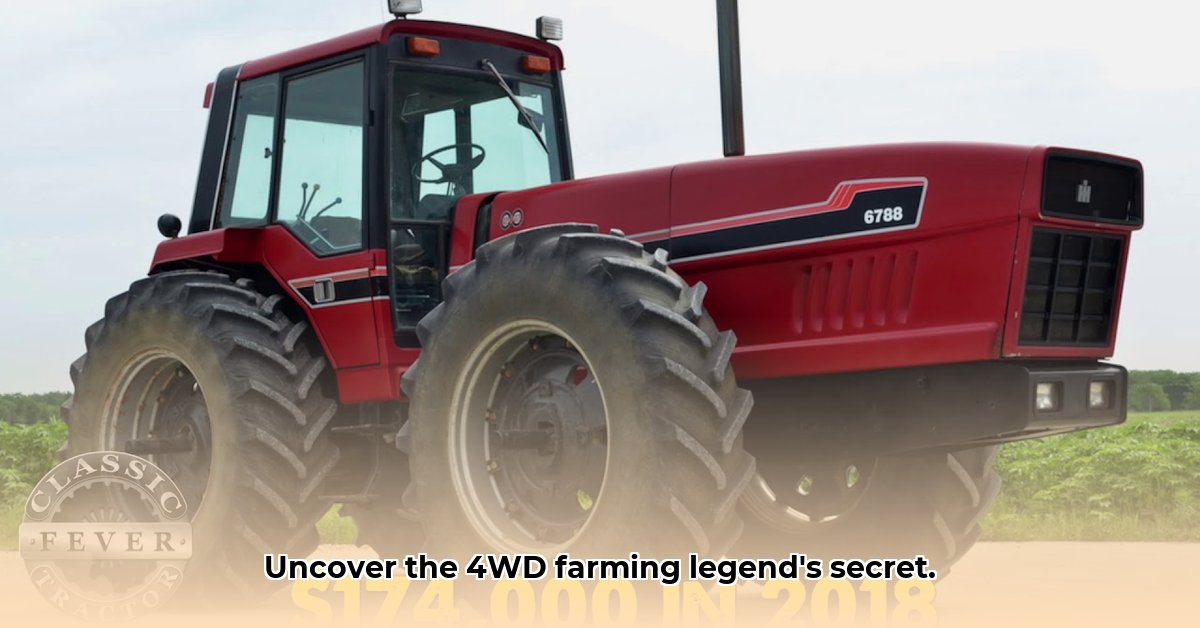
The International Harvester 2+2 tractor—a name echoing ambition and innovation—deserves more than a historical footnote. Produced between 1979 and the early 1980s, this wasn't your grandfather's tractor. It was a bold experiment, pushing four-wheel-drive technology and aiming for unprecedented maneuverability in row-crop farming. But its story is as complex as its innovative drive system. For more on other IH tractors, check out this page on International Harvester tractor specs.
A Powerhouse with a Twist: The 2+2's Bold Design
The 2+2 boasted a powerful DT466B engine (a proven workhorse), inheriting much of its robust design from the 1086 and 1586 models. Its weight distribution—54% rear, 46% front—provided exceptional traction. Early adopters lauded its power and ability to conquer challenging terrain. But the reality was more nuanced. Its sophisticated articulated four-wheel-drive system, while ingenious, proved a maintenance nightmare. The complex hydraulic system frequently malfunctioned, leading to costly repairs. Early models especially suffered from final drive issues, inherited from the 1086 but strained under the 2+2's increased power. Even seemingly minor components, like the muffler and air cleaner, proved less durable than anticipated. Could these problems have been overcome with further development? Expert opinion remains divided.
Did the 2+2's inherent design flaws doom its success? This leads to an important question: could more robust testing have mitigated these problems?
A Short but Memorable Run: Why So Few 2+2s?
Only around 10,000 2+2 tractors were ever produced—a remarkably low figure for a machine with such potential. Why this limited production? A key factor was the International Harvester's merger with Case. The resulting company, prioritizing consolidation, deemed this experimental machine unsuitable for its future product line. Thus, the 2+2, a pioneer in its field, was prematurely shelved, becoming a compelling "what if?" in agricultural innovation. This abrupt end prompts another question: did the merger's timing unfairly hinder the 2+2's chances for long-term success?
The number itself – roughly 10,000 units – starkly contrasts with the potential market for a truly versatile, high-performance tractor.
A Lasting Impression: The Legacy of a Bold Tractor
Despite its brief lifespan, the International 2+2 retains a special place among collectors and agricultural history enthusiasts. It embodies daring engineering and the relentless drive to improve farm equipment. Its story serves as a potent reminder: groundbreaking innovation demands careful design, rigorous testing, and a proactive approach to unforeseen complications. The 2+2’s legacy whispers of unrealized potential, symbolizing both progress and the risks inherent in pushing technological boundaries. Its impact resonates even today, shaping the design and development of modern agricultural machinery.
What can modern agricultural equipment manufacturers learn from the 2+2's successes and failures?
Weighing the Pros and Cons of the International 2+2
The 2+2's impact on agriculture is multifaceted, understood best through a comparison of its strengths and weaknesses:
| Pros | Cons |
|---|---|
| Superior power and exceptional traction | High maintenance costs and frequent repairs |
| Unmatched maneuverability for its time | Overly complex hydraulic system requiring specialized skills |
| Innovative articulated four-wheel-drive system | Short production run due to the IH-Case merger |
| Powerful and reliable DT466B engine | Issues with durability of certain components (muffler, air cleaner) |
| High PTO capacity | Early final drive designs proved inadequate under heavy load |
The 2+2 remains a subject of ongoing study and debate, a testament to the evolution of agricultural machinery and a stark reminder that even the most innovative ideas require careful execution for lasting success.
How to Restore a Vintage International Harvester 2+2 Tractor
Restoring a vintage International Harvester 2+2 is a significant undertaking, demanding dedication, skill, and resources.
Assessing the Beast: Before You Begin
Before starting, assess the tractor's condition thoroughly. A detailed parts inventory – including missing components – is crucial for budgeting and parts sourcing. Meticulous photography is vital for reference throughout the restoration.
Parts Acquisition: The Hunt Begins
Locating parts requires a multifaceted approach: online forums dedicated to classic tractors, vintage equipment specialists, and local salvage yards. Patience is your greatest asset.
The Restoration Process: A Step-by-Step Guide
The restoration process typically involves:
- Disassembly: Meticulous disassembly and labeling are paramount.
- Cleaning: Thorough cleaning, including rust removal and degreasing.
- Repair and Restoration: Engine rebuilds, bodywork repair, and more.
- Reassembly: Careful reassembly following detailed notes and photographs.
- Final Touches: Painting, detailing, and final assembly.
Budgeting for the Project: Facing Reality
Restoration costs significantly vary based on the tractor's condition, the restoration's scope, and the use of professional services. Expect a substantial investment.
Triumph and Tribulation: The Rewards of Restoration
Restoring a 2+2 offers significant rewards: valuable mechanical skills, connection with a passionate community, and ownership of a rare piece of agricultural history.